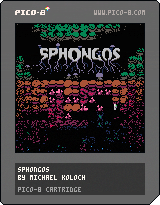
SPHONGOS
by mkoloch
-
Controls
Navigate the world and UI: Arrow keys/d-pad
Interact the world and UI: X key/X button (Both Pico-8 buttons work)
How To Play
Go out and gather samples from your surroundings
Research samples in the lab to unlock and upgrade abilities
The game saves everything automatically!
Post Mortem
This post mortem is mostly me documenting the development of SPHONGOS and sharing some of my
learnings. If there is anything specific you would like to know, just ask!
How it started
This game started as an entry for the A Game By Its Cover 2024 Jam on itch.io.
I had a rough last year and after failing to get anywhere with game development I turned to
Pico-8 and tried to give myself a proper time frame and goals. The idea was to finish no
matter what.
Why Pico-8
I felt like having seemingly endless possibilities with bigger game engines made me unfocused
and I thought a lot about unimportant things. I couldn't get to a point where I was making a
game.
The tools that Pico-8 provides are limited in a way that it feels like a creative challenge
and a puzzle to get your vision on the screen. It feels like a game in itself.
Coding in Lua is fairly easy and there is a ton of documentation and help online, I feel.
I always liked Pico-8 and since I got a Powkiddy RGB30 I played a lot of cool games from
splore.
Having my own game on this handheld device also seemed like a great motivation.
The Idea
The entries for the AGBIC jam are based on the cover art of the Famicase exhibition. I went
through the selection from 2024 and picked a few that I thought were inspiring. I landed on
Mushroom farmer https://famicase.com/24/softs/188.html
I didn't have time to properly start right away, so I had a while to think what I wanted to
do. In between I played Loddlenauts and loved the cleaning laser mechanic, because it is very
satisfying.
That's why I based the game around the idea of blasting fungi with a laser. Needless to say I
strayed quite a bit from the famicase inspiration.
Then I watched a few documentaries about fungi to have some knowledge to ground everything in.
That turned out to be very helpful for coming up with ideas and narrative as well as names for
things in the game. I had a few pages of notes about fungi and a bunch of words I could use to
make things sound a bit more sciency :)
Narrative
The basic narrative idea is based on the concept of global warming leading to fungi being more
resistant to the body heat of mammals. that's what keeps them from killing us at the moment,
but it is starting to change. It felt like a good hook to base a sci-fi game on. The game does
not explicitly mention any of that, but it helps to know what's going on in the world you are
building.
Development
Disclaimer: This is the second Pico-8 project I ever started and the first I finished, so some
of this might be old news, weird, or straight up wrong.
I started with brainstorming a basic structure and content I wanted to have in the game like
the upgrades, environments and life forms. It was faaar too much for the scope of the game of
course and I ended up ditching a lot of things. I wish I would have kept the scope smaller
from the beginning as I lost quite a bit of time working on systems that I ended up not
needing at all.
Playtesting
If you take anything away from this post mortem, it should be PLAYTEST as much and as soon as
possible! It helped more than anything to put this game into people's hands to see how bad it
is. The balancing was waaay off. No one understood the UI. People didn't even understand they
were dying. I learned so much from just observing people playing the game.
If you've never done playtesting:
For starters: get anyone, it doesn't really matter who
Advanced: Get multiple people, that have a diverse experience with gaming
Don't tell them anything about the game or how to play
You can give them a sheet with information that you can ship with the game if needed, but
sometimes it can help to just see them struggle and observe what they can figure out
Don't talk to them while they are playing. Don't help if they are stuck
- This can be hard to do, but it helps to let them figure out things and see how they do it or
what they do instead
- If they get stuck for very long, you can obviously help them out, but minimize the
information to what they really need to advance
Ask them to think out loud while playing
- Just observing is good, but If they do the streamer thing and comment everything they are
doing and what they are thinking while doing it, you'll get the most valuably information
- You will be surprised what people assume is going on or what they are supposed to do
Scope
That was my biggest problem overall in the development of the game: scope!
In hindsight, I should have worked more on the core mechanic of gathering the fungi and make
it as fun as possible. It became fun 2 days before release, when I sat down and implemented a
particle system. I was so stressed in that moment, because there was so much left to do, that
I timed the implementation and only gave myself 30 minutes to do it. Luckily it worked out and
it gave the game a huge boost. I then continued to use it in a lot of places to make
everything juicier.
I regret not having the time to implement anything moving into the environment. I had some
life form early on, but had to kick them, as I realized that I can't finish if I'm going to
make them work well and maybe even have to put in more.
Workflow
What I really liked about the development was my setup. I started out doing everything in
Pico-8, but after a while, it was mentally too draining to keep coding with the pixel font and
the tiny window. I switched to VSCode.
I started a Git repository, where I now have all of my Pico-8 projects, because I feel they
are too tiny to have a separate repository for every project.
That way I was able to work at my Windows desktop PC and my trusty Linux Thinkpad in the
kitchen or on the go whenever I felt like it.
The one annoying thing about working with an external IDE is that I sometimes made changes in
both VSCode and Pico-8 and lost some of them. If anyone knows a good solution for that other
than being more disciplined about it, please tell me.
Code
I'm not a programmer. I never properly learned how to code. I picked it up through making
games and other things over the years, so I can do quite a lot, but it might look weird to
someone who actually studied it.
That said, I wrote pretty much everything from scratch. The only thing I took from the demos
that ship with Pico-8 is the collision implementation, because I didn't want to waste the time
figuring it out myself.
I don't think there is anything terribly innovative about this game's code, but if you see
something you want to know more about, hit me up.
UI
I had a lot of fun working on the UI. As I have a background in graphics design, it comes
quite easy to me and I enjoy tinkering with details, which can be a waste of time. But I think
for this games it adds a lot to the sci-fi atmosphere.
One of the first things I had implemented was VHS like tearing effect of the screen. It gave
me a big boost in confidence and fun.
Here's how I planned out some of the UI elements. In the bottom-right I even drew the case
capacity display in pixels to make it all fit perfectly.
As I printed most of the main panel I setup a function to add a line with some parameters to
the UI. This function ended up being integral in getting a lot of information on the screen.
Map
Initially I planned to have a much bigger map. Luckily I was at a point where I could see the
scope being to big already, so I cut it in half. It is now 4x4 rooms that are split so they
occupy 8x2 rooms on the tile map.
Here is how I worked on the final map. This part felt like how you think game design would be,
but almost never is :D
I drew the basic layout and put down stuff to mark everything you can collect in the game and
where the rooms would connect.
When I was mostly satisfied I took the photo above and drew it on the map.
Polish
I started polishing and adding effects quite late in the development. Anything that has
particles was added 2 days before I uploaded the game for the first time to itch.io. A lot of
sound effects were changed or added after that, because the visual effects added so much that
I wanted to highlight them even more with sound.
I'm very happy with how the whole game looks and feels. It's a great feeling when someone is
playing it and you can hear where they are and what they are doing without looking.
Release
I know from experience that releasing games can be a lot of work, so I new I had more work to
do after uploading the game. I ended up re-designing the logo. Fiddled a lot with screenshots
and gifs. Fixed bugs. Implemented a few quality of life things after more playtesting. Fixed
more bugs.
Wrote this text!